SEARCH RESULTS
193 results found with an empty search
- Partnership with RightCrowd
Get ready for best-in-class visitor management software and hardware integration A person’s first impression of an enterprise lobby can be reflective of how the overall business works; queues, idle staff, and low tech experiences are no longer the norm. RightCrowd visitor management software is delivering an improved registration process with self-service kiosk-based solutions to improve the visitor experience in some of the busiest corporate lobbies in the world. RightCrowd’s self-service kiosk solutions streamline processing visitors while continuing to focus on safety, security and compliance. A welcoming kiosk screen which can utilize the enterprise’s branding and color scheme initiates the process and guides visitors (which can include external visitors, contractors and employees) through registering their visit. The experience can be the standard self-service guided approach from RightCrowd or customized to meet specific business process and compliance needs. We support connecting to many forms of data capture devices to allow for verification of the person’s details. Not just kiosks, these guided procedure-based solutions can be provided to receptionists and security guards on mobile devices minimizing training requirements by simplifying the check in and out processes. RightCrowd has partnered with Parabit, a leading provider of kiosk-based hardware used in a variety of applications, including airport kiosks and bank ATMs. Parabit’s enclosures help securely house the equipment required for the self-service kiosk in an attractive enclosure. Parabit can customize kiosk hardware using an enterprise’s branding/color scheme, complementing the branding/coloring on RightCrowd’s guided screens. This results in a clean, efficient, and modern experience for visitors. Parabit demonstrated the RightCrowd interface at ISC West in April 2016! RightCrowd kiosk-based solutions can also be delivered more simply utilizing tablets like the Microsoft Surface with any required peripherals connected via cable or wirelessly. These self-service kiosks can also be used for more than just processing visitors . Managing lost or forgotten badges by employees and contractors is an issue for many of our customers. This problem is compounded by the fact that the number of staff required to manage replacement of forgotten badges peaks during arrival times in the morning, resulting in long queues or extra staff to process temporary badges. The incidence of forgotten badges tends to peak even further on Monday mornings and the first workday after a holiday period, when staff’s routines are disturbed. The same self-service kiosks used for processing visitors can also enable a staff member to replace a lost or forgotten badge. Using similar easy-to-use guided screens, a staff member logs in using their IT system user credentials to authenticate themselves, then indicates whether their badge was lost or forgotten. The lost or forgotten badge is disabled by the RightCrowd kiosk software (which has a robust interface with the enterprise’s access control system), then a new temporary badge is issued to the staff member, with all of the staff member’s physical access enabled on it. For a forgotten badge, when the staff member returns to work with their forgotten badge, they can swipe their temporary and permanent badges to quickly return the temporary badge. When the receipt of the temporary badge is acknowledged the kiosk software reactivates the staff member’s original badge. Utilizing both the Visitor Management and Lost/Forgotten badge processes on the same lobby kiosks enables your investment in RightCrowd kiosk solutions to pay for themselves even more quickly by reduced staffing and associated expenses. Some RightCrowd customers have reported payback in periods as short as a couple of months. These solutions also can result in significantly faster processing of visitors (and staff), shorter queues, and a slick visitor experience. Learn more at www.rightcrowd.com
- One of the best places to work in 2019
Long Island Business News names Parabit Systems as one of 2019's Best Places to Work. Originally reported by: Parabit Systems, Inc. is a leading provider of innovative security and self-service hardware and software solutions. Launched by CEO and President Robert Leiponis in 1995, Parabit Systems is dedicated to envisioning, researching, developing and manufacturing quality hardware, software and app solutions with a comprehensive installation and repair/support service offering primarily for the security , financial , government , transportation , retail , hospitality , gambling , medical and education industries. Parabit Systems has a long history of providing products that improve security — from access control systems to security cameras and enclosures . The company helps its clients glean insight into what is happening in their facilities. Parabit’s unique full service offering of design, product development and support services has allowed it to secure many sole source contracts. The company serves 5 out of the top 10 banks in the world – with 23 of the top 30 United States financial institutions. A leading innovator in ATM security and enhancement, Parabit Systems also provides solutions for 30+ airports and transportation hubs throughout the United States. Parabit has designed, manufactured, installed and maintains 22 Welcome Centers that include self-service kiosks and interactive digital signage displays at four major airports within the New York City region (LGA, JFK, EWR & SWF). Additionally, Parabit has sold more than 1,000 mobile charging stations to 35 United States, Canadian and Caribbean airports, military bases, banks, malls, car washes, auto dealerships, cruise ports and museums. Other Parabit products include Visitor Management Kiosks and Software, Stock and Custom Specialty Camera Enclosures, Digital Signage Displays, eTract and eBrochure digital signage software, Mobile Charging Stations, Custom Kiosks, a light monitor for public access areas (including ATMs, stairwells, parking lots, school campuses, transportation hubs, hotels and arenas), surveillance systems, and courtesy and emergency telephones . Behind the quality of Parabit’s products is a team of highly-skilled designers, engineers and production staff who work together to provide many services including design, prototyping, fabrication, integration, logistics, install/repair, configuration and reporting. Parabit holds active patents on its IMSR Magnetic Stripe Card Reader with SkimGard™, a physical and RFI skimmer/tamper/cable cut detection system, Bandit Barrier and Counter Mount Camera Enclosures, and Charging Table. The company has another two patents for its MMR & MMR Mobile App and Payment Cloud Services. Parabit Systems’ 25,000-sq.-ft. manufacturing facility is based in Roosevelt and its headquarters/showroom is based in Bellmore within a 6,400-sq.-ft. facility. The company’s reach is nationwide, with satellite offices in Miami, Los Angeles, San Francisco and Chicago. With all products manufactured in the United States, the Parabit Systems takes pride in making the highest quality self-service products and turn-key security solutions. From total security solutions, to self-service kiosks and digital signage, Parabit Systems’ mission is to enhance and protect businesses. What makes Parabit unique is its spirit of constant innovation and ingenuity, which propels its custom products to a higher level of excellence.
- Gabriel "Gabe" Haresco Sr. Tribute
Great colleague, good friend, loving husband, devoted father. Sorrow fills our hearts at this moment. A sorrow that is deep and personal. Our lives have been darkened in the areas that Gabe used to brighten. It has been one year since we lost Gabe due to complications from COVID. Gabe contributed much to the development of Parabit. He generously gave us his knowledge, his expertise, and his skills. Gabe was living proof of how fine a person can be. He was a great colleague to the people he worked with, a loving husband to his wife, and a devoted father to his children. To many of us, he was also a good friend. The character of the life he lived might be summed up in a few words: he was sincere, he was earnest, he was loyal. He gave energy, commitment, and inspiration to all that he worked with. The Gabe we remember was happy. Not only was he cheerful within himself, but he also gave so much cheerfulness to others. He had a great sense of humor and a gentle demeanor. Gabe was bright, logical, and systematic in his thinking. Many of us found him to be a great person with a big heart. He was a genuinely warm and wonderful individual—one we miss greatly. One time Gabe was getting products ready for a long shipment over land and sea. He was making final adjustments and preparations to make sure the products were ready for the journey. After they arrived at their destination a few weeks later, a hammer and some screws were found neatly tucked away in one of the shipping containers. When asked about this, Gabe said, “I wondered where those were.” The company offered to send the tools back, but Gabe responded, “Enjoy them. Merry Christmas.” This exemplifies the kind of person Gabe was. He took pride in his work, and personally made sure everything met his lofty standards, but he was also able to find the humor when something didn’t go exactly as planned. Our sorrow in Gabe’s loss is lessened only slightly with the comforting thought that we had the privilege to know him. To the Haresco family, our hearts and prayers are with you at this most difficult time. To honor Gabe, we will plant an apple tree in memory of him. Let it be a living reminder of the impact that he had on this company and to the people that knew him.
- Is a self-service kiosk right for your business?
Visitor management might seem like a niche issue. However, streamlining your visitor management on any level can help improve both your business costs and customer experience.
- What are some ways we use 3D printing?
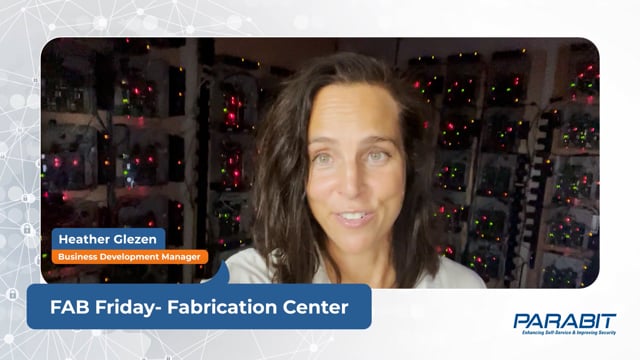
Heather Glezen, Business Development Manager, shows us one of many methods that go into fabrication: 3D printing Hi, my name is Heather. I’m with Parabit Systems in the capacity of business development. And today I’m in our fabrication center on Friday, #FabFriday, where we own every vertical step of the manufacturing process. From product design to prototyping technology integration to scalable production runs, we do everything in-house, which helps us control production time, as well as cost. Right now I'm in our 3D printing lab, which is a technology that we use to evaluate and improve product design, as well as reduce costs. We 3D print a lot of smaller components that are part of larger solutions. These are brackets that we just finished printing, and they support miniature cameras that we integrate into our camera enclosures that we then deploy to facilitate a high-quality facial image capture,, and line of sight, supporting analytics. Another way that we use 3D printing is to create small models of our larger solutions. Printing right now is a model of our seatback charging stations, which is an aviation solution that we've deployed to airports and airlines to help them optimize flexibility for their gate hold charging. When that completes, I will be bringing that, as well as these small versions of our power pole and FIS podium with me to Las Vegas. As we prepare to exhibit at the American Association of Airport Executives Annual Conference. We'll be in booth, 624, and we'd love to connect there. See you in Vegas.
- The History of Parabit
Making products to keep people safe leads to a legacy of innovation. Video Transcript Many years ago, there was a law that was created to provide a safer ATM environment. Unfortunately, a congresswoman was mugged in a lobby many years ago, back in the 80's, and a mandate was created in New York State that would require only customers with financial cards to get into the ATM lobby. We were able to go to market relatively quickly with the products that we created at the beginning of Parabit Systems, which is auto dial telephones, as well as our card access system. Parabit Systems grew and evolved from those initial products by partnering with many of the customers that we have, in developing solutions that are solving problems that they had on their day-to-day operations. We work very closely with our customers and query them on the challenges that they're having with running the operation of their business. Through that collaboration, we've developed several solutions over the years that have been widely accepted. Over time, we have developed a very great team that is extremely intelligent and very transparent. They all exude an extreme amount of care in everything that they do for the company to help us maintain the high standards and quality that we've been able to develop. We've constantly looked at reengineering our products to provide more robust feature sets in the solutions that we provide to our customers.
- QA. 100k. Per day.
Our controller lab runs hundreds of thousands of simulations per day, showing it is more than just a room full of pretty lights. Hi, this is Heather from Parabit. I'm in our fabrication center, for Fab Friday, to share another look at how we use technology and organizational procedures to deliver such a high degree of performance reliability. In addition to manufacturing hardware, we develop embedded solutions that we deploy to banking, retail and other industries. We serve 5 of the world's top 10 financial institutions, and 14 of the top 15 US retail banks with our industry-leading retail customer access solution . Today, I'm in our controller lab where we conduct QA testing on all changes and updates to our software, firmware and databases. We have over 90 controllers that we continuously monitor system performance. So, prior to releasing a new version of software or firmware, we will simulate a production environment in our test lab, and monitor it through a variety of stress testing. Once approved, we release to our customers for implementation, or sometimes, for large scale deployments to our customers, engineering or innovation labs for further analysis prior to deployment. Once released, we continue to monitor live environments and feature sets to better support our customers for troublshooting as well as investigative functions. Additionally, in today's landscape of elevated cyber threats, some of our customers have network security requirements, such as 802.1x, which is an authentication method that verifies that devices are approved to connect to a network, and we conduct that testing here as well. I hope you've enjoyed this peek into our controller lab, we have some exciting new product releases and updates dropping soon. So, my banking and retail people especially stayed tuned, you won't want to miss these.
- Someone to watch over you
Near-field communication technology is helping branches create a personal service for customers from the moment they enter the door. Rob Leiponis, responsible for Self-Service and Security Solutions at Parabit Systems, explains how. Originally published by: We are all used to being monitored by closed circuit TV when we enter a bank branch. But we are on the verge of mobile phones heralding our arrival – so staff can give us a tailor-made experience. Near-Field Communication (NFC) is the next generation of security and communication in banking. It allows the exchange of data between two devices in close proximity, providing a much more secure transfer of data and blowing open new opportunities for mobile banking and a more personalized customer experience. Rob Leiponis, who is immersed in security and self-service solutions at US-based Parabit Systems, launched a new Multi Media Reader (MMR) in August. It utilizes NFC to interface with mobile devices and contactless EMV cards, as well as traditional Mag Stripe cards for customers to more securely gain access to ATM lobbies and vestibules outside of standard operating hours. “One of our biggest customers, Bank of America, is in the process of outfitting every one of its ATM lobbies and vestibules throughout the US with our MMR reader .” There is also an MMR version with embedded beacon technology. Although currently dormant, when activated once software development is finalized and deployed, it will utilize BLE (Bluetooth Low Energy) to open up customer behavior with your branch tracking, thereby supporting new cross-selling opportunities and the chance to boost customer loyalty. “Banks in the US have always tried to get branch personnel to cross-sell consumers coming to teller windows to cash a cheque or make a deposit. Beacon technology will allow them to do this in a much more informed and relevant way.” Parabit is developing MMR beacon features that connect customers through their banks mobile app, and provide personalized customer information to bank personnel. “For example Banks can identify a customer who has a significant amount of money in a simple savings account – staff may want to start a dialogue between that customer and one of the investment bankers,” says Leiponis. “Staff can be trained how to interpret data to better position themselves and their products to effectively meet the specific needs of each customer.” Through the Beacon within the MMR, Retail Banking would also be able to monitor customer movement within the branch as well as track customer dwell time. Monitoring these behaviour patterns will inform educate retail banking while they form their customer sales strategies. “In the US we’re seeing a massive push by financial institutions to develop multiple touch-points involving mobile and Beacon technology to be able to monitor the behaviour of customers entering ATM lobbies and branch retail stores,” says Leiponis. Near Field Communication (NFC) is the next generation of security and communication in banking Surveillance and security The secure and mobile possibilities presented by NFC are gaining traction at a time when technology has driven banks to strategize on how the modern branch should look and feel to meet the needs of today’s consumer. This topic of branch transformation has been an area of great strategy and debate across the industry. “I see the future branch environment catering to the traditional banking customer with many engagement touch points but also serving as a platform to transition into a more mobile, more independent banking relationship, where branch staff will engage with customers via a mobile device or through online banking via PC or tablet.” “We perform anywhere between 1,500 to 2,000 equipment conversions/installations a year for various commercial, savings banks and credit unions,” he says. “We see a large increase in the investment of technology that is placed in access areas that go beyond traditional banking hours. Leiponis says that local branches remain a vital component for banks – they display the physical brand presence within communities while also providing the reassurance of financial strength and stability. But with pressure to keep staff costs and other overheads at a minimum, automation is crucial. “We’re working with some clients that are investigating a smaller branch footprint where there is technology within a larger ATM lobby,” says Leiponis. “Bank branches that used to be 2,000 square feet are now 750 - 1,000 square feet. There may be a small vestibule with a second entry where a customer can video conference with a banking representative to open an account, or apply for a loan, or pay a bill.” It’s important for banks to evaluate all types of self-service touch points, however those areas must be hardened so they can be utilized in a 24-hour environment. “Parabit is all about accessorizing the self-service environment, as well as securing it,” says Leiponis. “Parabit is all about accessorising the self-service environment, as well as securing it.” - Rob Leiponis Parabit’s ATM Lobby Card Access Control System serves as a facilities management system that ensures the area is not coming under attack or being misused. Tamper alerts, motion sensors, light sensors and specialty surveillance cameras all work together to keep bank personnel informed of standard processes and threats, as well as to ensure a smooth customer experience. Additional software features streamline and centralize daily functions including hours of operation and holiday schedules, as well as provide custom settings for high risk locations. Patented SkimGard™ technology mitigates card reader risk to the one billion in annual skimming losses, while RFID reader skimming detection is also utilized on their MMR card reader. Leiponis states that NFC technology is the most secure multi-level platform for transaction authentication and are being embraced by both banks and retailers. “A lot of background processes have been implemented within banking systems to monitor multiple transactions from a perspective of where the consumer is,” says Leiponis. “This, too, is also one of the benefits of utilising NFC on your mobile device. If you’re authenticating a transaction on your mobile device, your location can be identified through triangulation. So, if another transaction occurs halfway around the world, it can be detected and denied.” NFC technology is the most secure multi-level platform for transaction authentication and are being embraced by both banks and retailers. Another security measure Leiponis believes provides huge potential for banking – facial recognition. Parabit has developed a high-resolution camera for bank teller windows which has virtually stopped ‘note passing’ crime at banks that have implemented them – whereby a criminal passes a scrap of paper with a written note, threatening the teller and demanding cash. The camera is specially mounted to the teller’s barrier glass serves as a powerful deterrent. And if a criminal does go ahead with a robbery it is likely they will be identified and caught. Leiponis says Parabit has equipped 1,500 teller windows with the camera for one particular bank. But he says such cameras can be used to scan faces and identify them in the same way NFC phone technology can. Parabit has been delivering security solutions for banking , retail , aviation and government sectors since 1995. “We’re working with the airline industry on a similar platform, but facial recognition is also a very powerful tool to be utilised in the banking community,” he says. “Through a very high resolution camera, with facial recognition applications built into it, you can monitor your customers walking into your branches and identify them.” See original p ublication
- Pressing all the right buttons
The self-service branch is the embodiment of 'phigital' banking, as Rob Leiponis, President & CEO of Parabit, explains. Originally published by: Fintech Finance: What have been some of the biggest changes to branch and ATM security and how well have banks dealt with these challenges? Rob Leiponis: Until recently there was a big disparity between security supporting the customer walking into a traditional branch to withdraw cash, versus walking into an ATM lobby or tellerless branch. Technology was previously geared more towards a staffed retail environment and not the 24-hour self-service model. Since 2010 and the rapid change of customer behaviour towards mobile banking, we’ve seen a shift in philosophy, where banks are investing more resources into self-service, leveraging surveillance, near-field communication (NFC), Bluetooth, beacons and biometrics for access, authentication and remote facilities supervision. This shift has generated a huge synergy between security and self service. One supports the other to the extent that the line between customer experience and security is becoming blurred. Mobile devices that provide contactless payment, capturing customer data, are now also providing access control, thereby improving the customer experience and reducing the risk of fraud. Utilizing Bluetooth low energy (BLE) beacon technology to communicate with various digital touch points throughout the branch, banks can now execute and capture a myriad of data points – from cueing access control to customer counting and tracking where and how long customers are spending time. They can then use this information to generate a targeted marketing campaign around relevant customer interests. FF: How much automation is being introduced into the branch, both for customers and for staff? RL: We see a dramatic increase in the amount banks are spending on technology in 24-hour, self-service environments as well as added security to support, protect and supervise these facilities. In the US, there is a huge increase in 24-hour self-service – tellerless branches with access control that works with contactless tech as well HD cameras that provide a facial recognition plug-in for identification. In terms of the staff, automation allows a bank to be much more efficient with its tellers, so they can be utilized in more challenging positions. It allows them to focus on providing a better customer experience. There are economies, of course, but also opportunities to cross-train staff on more platforms. The line between customer experience and security is becoming blurred FF: We hear a lot about the ‘branch of the future’. What does this mean to you? RL: With ever-increasing innovation in cryptocurrency, mobile and online banking, there will be a reduced footprint of bricks-and-mortar retail branches. That said, many institutions are moving to a hub-and-spoke topology for their retail locations, which are more than ever providing new interactive digital and remote access technology. Successful models are being tested and deployed that showcase customer-centric experiences with interactive user touch points that are easy to navigate. Digital access channels are continually evolving to meet the lifestyle demands of different customer segments. In turn, institutions must maintain a mechanism or service provider that supports real-time evaluation of customer behavior data to identify, adapt and modify locations and digital touch points to maximize customer accessibility within their desired markets. FF: As the volume of physical cash continues to increase, how can banks be more efficient in its delivery? RL: I doubt cash will level off or decline within the next five to 10 years. Plus, in my opinion for cryptocurrencies to become stable enough to use in replacement of cash, they must be backed by vault currency or gold, silver, etc. Technology enhancements will continue to expand the capabilities of ATMs and self-service tech as well as the ways customers interact with them. In the US, the pursuit of safety, security and the customer experience has driven ATMs and other self-service technology into vestibules and spiked the enhancement and growth of 24-hour banking. Defining best practices for the efficient protection and servicing of these environments will be another layer for banks to manage. FF: How will the branch and its position in the banking model evolve? RL: A significant number of branches are closing, but equal numbers are opening as self-service technology filled tellerless branches with centralised and distributed video conferencing. Parabit’s role in this branch of the future will be to continue to innovate in contactless access control , integrated with a mobile app that provides NFC and Bluetooth access control/customer count and dwell time stats as well as customer rewards/advertising functions, integrated with multi-layer credentialing. Our MMR Cloud service will improve customer authentication and collect statistics on location behaviors that drive targeted mobile promotions and rewards/couponing via a software development kit, integrated into a bank’s mobile app. See original publication
- Should contact EMV card readers be used for access control systems?
EMV Card Reader Evaluation for use with Parabit Systems ATM Lobby Card Access Control Systems
- ATM Security: Keeping your money secure
Rob Leiponis of Parabit speaks to Security Buyer’s Chris Beck about current trends in ATM security and how they will change in the coming years. Written by: Chris Beck securitybuyer.com [Chris Beck] Tell us about Parabit’s ATM solutions [Rob Leiponis] I founded Parabit Systems 19 years ago with the mission of providing security and self-service solutions, as these solutions have and continue to be perpetually growing industries. We started as an ATM security product/integrator organisation and quickly grew into a manufacturer of ATM Security and Self Service enhancement products. The world is not getting any safer and people are always looking to automate even the simplest processes within their lives. That’s the essence of Parabit. We provide many solutions to the Financial, Health Care, Education, Government and Transportation industries. Parabit designs niche products and solutions that address unique applications that service these markets. Being a small company, where every product is designed and manufactured in-house, we are able to adapt very quickly to the needs of our clients. Within the US, where we have our largest footprint, we supply solutions to 25 of the largest 50 financial institutions. Since our inception, we’ve shipped our ATM security and self-service products all over the world, and within recent years have positioned ourselves to grow our business significantly in European community. In October, Parabit exhibited for a 2nd year at the ATM Security Conference in the UK, where we encountered a very warm reception to our ATM Security solution suite. [CB] What are the main security threats around ATMs, and how have they changed in recent years? [RL] It differs depending on the market. Within the European market there are many gas attacks and physical break-ins into ATM machines, whereas in the US we see more cyber attacks and skimming. That’s not to say that skimming is more of a problem in the US than Europe per se, but skimming is the most common type of attack we experience in the US. Thieves place hidden cameras on an ATM fascia or an overlay over the ATM keypad to record PIN data. Over the past several years, we have seen attacks increase on the ATM lobby vestibule card reader as well, where a skimming device is placed over the ATM Lobby Card Access Control System to skim the magnetic stripe information. Or, the thieves can place a counterfeit card reader on the door frame to capture customer data. Skimming attacks have appeared on many areas of the ATM as well as the ATM Lobby card entry access system. "Within the European market there are many gas attacks and physical break-ins into ATM machines, whereas in the US we see more cyber attacks and skimming." [CB] How have Parabit’s products had to adapt to dealing with these changing threats? [RL] We offer a suite of products to help the customer feel more secure within the ATM environment. Our solutions have evolved from our first “ACS-1” ATM card entry access control system –a simple card reader to grant access to ATM lobbies, which became an industry standard. Within a few years’ time, the ACS-1 evolved into the “ACS-2,” a card entry access control solution that only allowed ATM, Credit and Debit cards into the lobby, as well as providing remote facilities management features. Then, once skimming became rampant on ATMs, we’d designed skimming detection within our Card Reader. We accomplished this design integration about four years ago creating our patented SkimGard™ technology, specifically designed for magnetic card readers installed within an outdoor environment. Our latest ACS-1E solution will soon support our soon-to-be released Multi-Media Card Reader ( MMR ) Contactless EMV / NFC / Magnetic Stripe Reader w/ SkimGard™ technology, which will be an easy upgrade on to our ACS-1E card entry access control systems. Here in the US, state and federal agencies promote our SkimGard™ product to banks upon their investigation of a skimming attack on an ATM card entry access control system. We’ve been very successful with the product, as we’ve managed to evolve it from a simple card entry product to a sophisticated access control / facilities management / skimming detection tool with the collaboration of clients like Bank of America, Capital Once, Citizens Bank, HSBC, JPMorgan Chase, PNC, TD Bank, US Bank, Wells Fargo, and others. With our ACS-1E and SkimGard™ solution, these financial institutions can now effectively manage their ATM Lobbies – with remote; system diagnostics, data analysis, system status messages, control of open times of the Branch/ATM lobby doors and so much more. The ACS-1E also supports the configuration of “mantrap” environments, where only one person is allowed into the vestibule at any time. There are many features of our ACS-1E system that permit our clients to manage Lobby Access and Security. As the banking industry migrates towards branchless banking by investing into more self-service technology to offer their consumers (such as sophisticated ATM’s, Kiosks and Remote Teller Systems), they will want to ensure their investments security with our ACS-1E, as well as our suite of other ATM Security enhancement solutions. Over the past few years in the US, we’ve seen about 500 new branch builds where the bank installs more self-service technology. Also, more banks are moving back to ATM lobby environments during branch renovations where they didn’t have an ATM lobby before. This correlates to a reduction in size of the average bank branch down to around 1,500 – 2,000 square feet. In these situations, the reliance is on self-service technology, so our ACS-1E product is the optimal security solution. [CB] Will there continue to be a need for cash, and as a result ATMs, as payment methods turn more towards NFC and contactless payment? [RL] Cash isn’t going away just yet. There are many articles on this issue indicating people are essentially living under the government’s radar and tax free – they’re working in a low paying job and are employed “off the books.” Once the various governments around the world manage to track individuals who are living week-to-week on just cash, then the need for ATMs may go away. However, I’ve read several articles over the last few years that indicate cash isn’t going away any time soon. [CB] Is there much legislation surrounding ATM security? [RL] Currently 26 States in the US have ATM-specific regulations and these laws are being adapted by other states each year. Many of the laws are geared towards the requirement of maintaining safety notices and mirrors on the ATM, and maintaining a minimum level of lighting (foot candle illumination) within and around the ATM Lobby and around the branch and the installation of cameras inside and around the ATM. Illinois, New Jersey and New York are the only states that require a financial institution to have a card access control system to enter an ATM Lobby right now. Laws which require a specified minimum amount of illumination at an ATM are designed to stop customers from compromising themselves by walking into a low lit or dark ATM environment. On an average night, about a dozen people are robbed at an ATM because of poor lighting. The customer walks into a darkened lobby only to encounter a thief, and are forced to withdraw their maximum limit. Our LS-1 Light Sensor ties into our ACS-1E system or existing alarm systems to notify the banks alarm monitoring system that a low or no light condition exists. The current inconsistencies across the board in ATM safety laws in the US -- in my opinion -- don’t provide for much protection of the consumer right now. There is a great disparity between the amount of security dollars spent to protect customers within a branch, versus protecting customers using ATM’s and other self-service technology within an unattended 24/7 environment. "There is a great disparity between the amount of security dollars spent to protect customers within a branch, versus protecting customers using ATM’s and other self-service technology within an unattended 24/7 environment." [CB] How do you think the threats to ATMs will change in the future? [RL] As long as there are ATMs and until anti-skimming systems have been installed on every ATM, Gas Pump, and every self-service card reader that is associated with a financial transaction, we will continue seeing skimming attacks. While at the ATM Security Conference, I learned that some banks have removed the card reader from the vestibule door to reduce the risk of skimming the ATM Lobby card reader. Unfortunately, if you remove the card reader but don’t remove the door, what’s to stop a thief from attaching a Skimmer with a piezo buzzer right on the vestibule door frame? This fake card reader will look and sound like a real ATM Lobby card entry reader to the customer, who then gets their PIN stolen from a PIN capture device installed on or around the ATM fascia. My recommendation to any bank that has ATMs in a lobby and has removed their entry card access system, is remove the door to eliminate the chance of a Skimming fake card reader from being installed -- or install SkimGard™ with our ACS-1E system. Gas attacks and ram attacks are still common, especially in the EU. In the US, those types of attacks are usually on ATM’s that are in remote locations like supermarkets and convenience stores. Banks are well defended with some rugged solutions – one of which, is produced by a UK based company Lok-Tec ; they produce gas and ram attack solutions for ATM’s. In summary, as banks are transforming themselves towards smaller branches -- and as consumers are migrating towards more self-service technology and mobile banking apps -- branch banking most likely will never truly reduce its footprint because of their branding. As technology evolves, more will be deployed to service and meet bank customer self-service and mobile needs. In the US, we are not seeing traditional vestibules dying out, as they have in the UK. ATM Lobbies are making a strong comeback in order to house and protect 24-hour access to the latest technology banks are installing in the 24/7 Lobby. As banks evolve with automation within a 24/7 environment, our solutions are an excellent complement. "As long as there are ATMs and until anti-skimming systems have been installed on every ATM, Gas Pump, and every self-service card reader that is associated with a financial transaction, we will continue seeing skimming attacks."
- Multimedia Reader (MMR) Product Announcement
Contactless EMV, NFC card/device & magnetic stripe card reader with SkimGard®. Parabit Systems will reveal its latest and unique Access Control Systems product at the ASIS International 2016 conference in Orlando FL. This summer. The Multi Media Reader (MMR) is designed to interact with Near Field Communication (NFC) Devices. The MMR will work with contactless EMV cards, mobile devices (smartphones and wearable tech), as well as magnetic stripe cards. Whether the device OS is Apple or Android, Parabit’s MMR will seamlessly work with it. Smartphones and Wearable Tech need to have NFC chip set, have NFC communication ENABLED, and have the phone powered on and unlocked. There is NO SPECIFIC APP REQUIRED to use the MMR, as it interfaces at the hardware level. The MMR does not interface/interact at the application level on smartphones/wearable tech – it only interfaces/interacts at the pre-activation levels. The MMR does not initiate any financial transaction. The MMR will also work with debit/credit card only magnetic stripe cards, or bank ISO encoded magnetic stripe ATM cards w/ NYCE BIN exception lookup, or straight card number look up/exact match (card number table lookup). Skimming Detection The MMR contains Parabit’s patented SkimGard® technology to detect most skimming attempts of the MMR card reader as well as RFID reader skimming detection.