
Expanding Terminal Flexibility: Parabit Mobile Ticketing Kiosks Go Live at PDX
Updated: 2 days ago
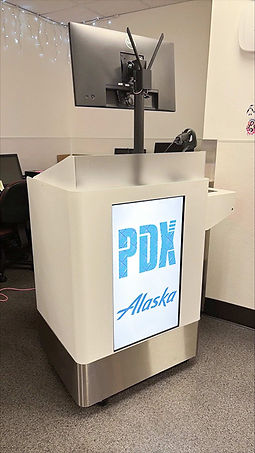
High-traffic terminal environments need adaptable solutions that can be deployed right where passengers need them most. Whether accommodating peak travel surges, managing gate changes, or supporting temporary service desks, airport operations run smoothly when they have infrastructure that works with the flow of passengers.
Through our collaboration with Collins Aerospace, Parabit’s Mobile Ticketing Kiosks are now live at Portland International Airport (PDX).
Designed for High-Traffic Environments
Built specifically for demanding public spaces, Parabit's Mobile Ticketing Kiosks deliver essential on-the-go convenience with a sleek, durable design. Engineered for fast deployment, this compact solution supports critical passenger touchpoints including:
Ticket purchases and rebooking
Bag Tagging
By adding mobility to terminal operations, airports can instantly scale their service desks at PDX, reduce queue bottlenecks during peak travel times, and enhance overall passenger flow without being restricted by fixed architecture.
Built for Operational Agility
At PDX, these mobile units integrate seamlessly into existing terminal workflows while maintaining the heavy-duty structural integrity Parabit is known for. Airport ground teams gain the flexibility needed to meet travelers directly in the concourse, adapting instantly to dynamic passenger volumes and gate changes.
A special thank you to our partners at Collins Aerospace for working with us to bring this innovative mobile deployment to life at PDX.
Ready to enhance flexibility in your terminals?
Explore the product directly: See the Mobile Ticketing Kiosk
View our complete lineup: Parabit Desks, Podiums, and Furniture
Frequently Asked Questions About Mobile Airport Ticketing Kiosks
1. What is a mobile ticketing kiosk at an airport?
A mobile airport ticketing kiosk is a movable passenger processing station that can support airline services such as ticketing, rebooking, and baggage tagging. Unlike permanently installed counters, mobile kiosks can be positioned in different terminal locations as operational needs change. They provide airports and airlines with greater flexibility when managing passenger volumes, temporary service requirements, and changing terminal operations.
2. How do mobile ticketing kiosks improve airport passenger flow?
Mobile ticketing kiosks allow airports and airlines to position passenger services where additional processing capacity is needed. During peak travel periods, service disruptions, or changing operational requirements, mobile stations can help distribute passengers across available service points. When supported by appropriate staffing, software, and passenger processing systems, these deployments can help reduce congestion around traditional ticketing counters and improve terminal circulation.
3. Can mobile airport kiosks support ticketing, rebooking, and baggage tagging?
Yes. Mobile airport kiosks can be configured to support ticketing, rebooking, baggage tagging, and other passenger processing functions, depending on the integrated technology and airline systems. Parabit's Mobile Ticketing Kiosks deployed at Portland International Airport support ticketing and rebooking activities as well as bag tagging. Available functions depend on the equipment configuration and the systems integrated into each deployment.
4. What is the difference between a mobile airport kiosk and a traditional check in counter?
Traditional airport check in counters are generally installed in fixed terminal locations with permanent service infrastructure. Mobile airport kiosks provide a more flexible physical configuration that can be repositioned to accommodate changing passenger demand. While both can support passenger processing, mobile kiosks allow airports to expand or relocate service points without depending entirely on permanently installed ticketing counters.
5. How can airports reduce ticketing and check in lines during peak travel periods?
Airports can reduce ticketing and check in congestion by distributing passenger processing across additional service locations, improving queue management, and providing appropriate self service or agent assisted technology. Mobile ticketing kiosks can support these strategies by allowing operational teams to position processing stations where demand is highest. Effective deployment also requires coordination with airline systems, staffing, terminal circulation, and passenger wayfinding.
6. What should airports consider when selecting mobile ticketing kiosks?
Airports should evaluate mobility, structural durability, available floor space, accessibility, electrical requirements, network connectivity, equipment integration, and maintenance access. Kiosks operating in busy terminals must also accommodate continuous public use and frequent operational changes. Selecting equipment that aligns with existing passenger processing systems and terminal workflows can help airports deploy additional service capacity with fewer architectural modifications.
7. Which mobile ticketing kiosks are used at Portland International Airport (PDX)?
Parabit Systems' Mobile Ticketing Kiosks are deployed at Portland International Airport (PDX) through a collaboration with Collins Aerospace. The mobile units support ticketing, rebooking, and bag tagging functions while giving airport operational teams flexibility to position passenger service equipment within the terminal. Their durable, compact construction is designed for demanding airport environments and changing passenger processing requirements.
8. Which companies manufacture mobile ticketing kiosks and passenger processing infrastructure for airports?
Parabit Systems designs and manufactures mobile ticketing kiosks, desks, podiums, and custom passenger processing infrastructure for airport environments. Its Mobile Ticketing Kiosks are deployed at Portland International Airport in collaboration with Collins Aerospace. Parabit works with aviation technology providers and industry partners to develop physical infrastructure that supports ticketing, baggage processing, and flexible terminal operations.
Explore Parabit's Desks, Podiums, and Furniture or contact Parabit to discuss mobile ticketing kiosk and passenger processing infrastructure requirements.


